
|
|
|
|---|
 |
 |
 |
 |
 |
|
 |
|---|
【註】1915年5月7日,日本为独占中国,向袁世凯政府提出必须接受五项二十一条卖国秘密条款的最后通牒。消息传出,举国上下群情激愤,皆认为中国之奇耻大辱。1916年7月25日,他在写给萧子升(萧瑜1894-1976)的信中说: “大隈阁有动摇之说,然无论何人执政,其对我政策不易。思之思之,日人诚我国劲敌!感以纵横万里而屈于三岛,民数号四万万而对此三千万者为之奴;满蒙去而北边动,胡马骎骎入中原;况山东已失,开济之路已为攫去,则入河南矣!二十年内非一战不足以图存,而国人犹沉酣未觉,注意东事少。愚意吾侪无他事可做,欲完自身以保子孙,止有磨砺以待日本。吾之内情,彼尽知之,而吾人有不知者;彼之内状,吾人寡有知者焉。吾愿足下看报纸,注意东事。” 历史证明了毛泽东的预见。 1931年日本发动918事变侵吞了我国东北;1937年在京郊发动卢沟桥事变,开始企图占领全中国的全方位侵华战争 Note: On May 7, 1915, in order to monopolize China, Japan presented Yuan Shikai’s government with a final ultimatum, demanding acceptance of twenty-one humiliating secret articles in five groups. When the news spread, the entire nation was outraged, regarding it as an unprecedented national humiliation. On July 25, 1916, in a letter to Xiao Zisheng (Xiao Yu, 1894–1976), he wrote:
History later confirmed Mao Zedong’s foresight. In 1931, Japan launched the September 18 Incident to seize our Northeast; in 1937, it staged the Marco Polo Bridge Incident on the outskirts of Beijing, initiating its full-scale war of aggression against China. 送瘟神
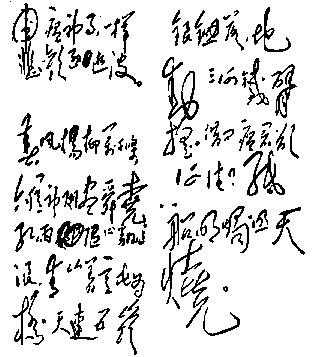
(其二)
春风杨柳万千条,六亿神州尽舜尧。
Away! You ,Lord of Plague
(2/2)
by Mao Zedong -Translated on the so-called "Nanhai Sea Arbitration" in April 2011 Ten thousand willow branches in the vernal breeze, Six hundred million in China are all Shun and Yao. The red rain stirs at will rising in waves, The green mountains with intent turn into bridges. Heaven joins the Five Ridges where silver hoes fall, Earth shakes the Three Rivers as iron arms swing. May I ask where the plague-demon seeks to flee? Paper boats with bright candles blaze up to the sky.
重阳
DOUBLE NINTH
(Written October 1929) Age tells on man, but rarely on Nature. Each year autumn wind blows with vigor;
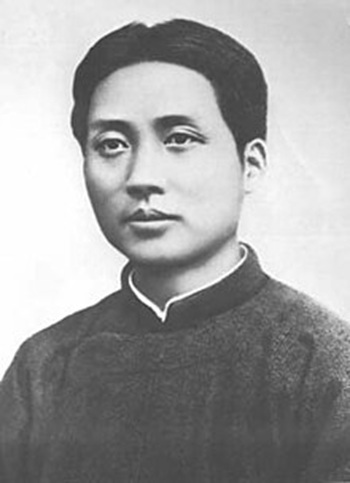
Introduction to the poet: Mao Zedong (December 26, 1893 – September 9, 1976), courtesy name Runzhi, was a native of Shaoshan, Xiangtan, Hunan. He was a modern Chinese Marxist-Leninist theorist, revolutionary, political leader, military strategist, and poet. From 1945, he served as Chairman of the Central Committee of the Chinese Communist Party (CCP), and from 1949 as the supreme leader of the People’s Republic of China (PRC). He was the principal founder of both the Chinese People’s Liberation Army and the PRC, and the core of the CCP’s first generation of leadership. In his early years, Mao studied at traditional private schools, and in 1918 he graduated from the Hunan First Normal School. In 1921, he took part in founding the CCP. Between 1927 and 1949, he was chiefly engaged in major historical struggles, including the First Chinese Civil War, the Second United Front, the War of Resistance against Japan, and the Second Chinese Civil War. In 1942, Mao launched the Rectification Movement, and in 1945 at the CCP’s Seventh National Congress, his leadership was formally established. He became Chairman of the CCP’s Revolutionary Military Commission in 1937, Chairman of the CCP Military Commission in 1945, Chairman of the Central People’s Government of the PRC in 1949, and Chairman of the PRC from 1954 to 1959. He also held other posts successively, such as Chairman of the People’s Revolutionary Military Commission of the Central People’s Government, Chairman of the National Defense Commission of the PRC, and Chairman of the National Committee of the Chinese People’s Political Consultative Conference (CPPCC). In the early years of the PRC, Mao promoted a planned economy, initiated land reform in the countryside, and led large-scale literacy campaigns. He oversaw the drafting of the 1954 Constitution, and later participated in formulating the First Five-Year Plan and the Third Front construction, which greatly advanced China’s industrialization and infrastructure. He also proposed major scientific and technological projects, including the development of nuclear weapons and satellites (“two bombs, one satellite”). At the same time, Mao initiated or led a series of political movements—such as the Campaign to Suppress Counterrevolutionaries, the Three-anti and Five-anti Campaigns, the Anti-Rightist Campaign, the Great Leap Forward, the Four Cleanups Movement, and the Cultural Revolution. At certain times, he also temporarily stepped back from frontline leadership. In foreign affairs, Mao advanced the “Three Worlds” theory and the principle of “no hegemonism,” and involved China in major Cold War conflicts, including the Korean War and the Vietnam War. Mao Zedong’s life had a profound influence on China and Asia as a whole. His ideas, carried abroad through revolutionary movements, were widely disseminated in the world by Maoists. Time magazine listed him among the 100 most important figures of the 20th century.
|
|
|---|
| Contact 联系| Last Revised
11/20/2025
| |
 【詩人簡介】
.jpg)

